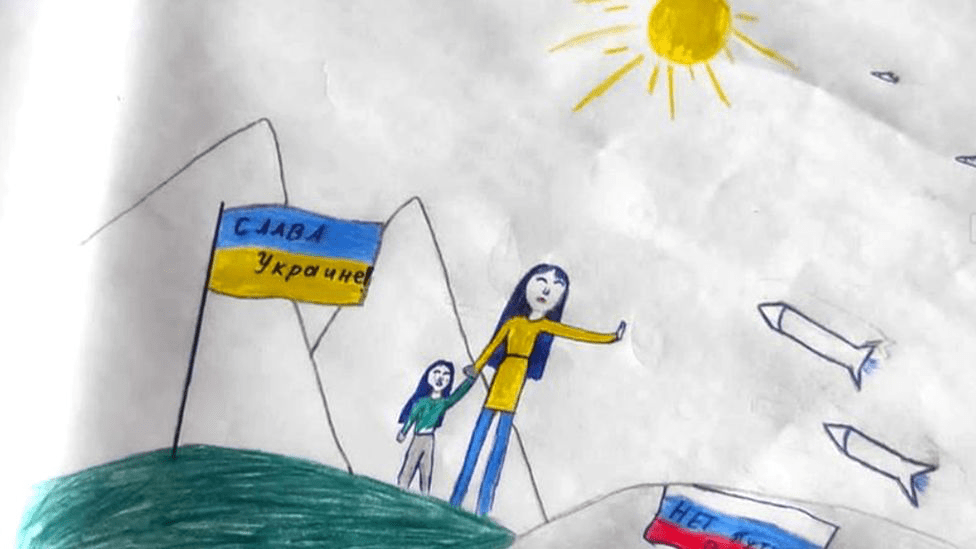
‘Dad, the police almost caught me. I drew a picture’ – Masha Moskalev, age 13. In April 2022, the young girl was seen drawing a picture in her school’s art class. Not a big deal, right?
The supposedly ‘anti-Russian’ picture contained 2 flags- Russia and Ukraine. With ‘нет войне, слава Украине’ (No to war, glory to Ukraine) was written above it. Since then her life has drastically changed; over a few scribbles on a page.
She is now confined to a social rehabilitation centre completely alone. Her father, Alexey Moskalev, faces up to 3 years in prison and has been stripped of all parental rights. He vividly recalls how he and his daughter were treated like terrorists by the FSB (Federal security service)- “They said they would take her away from me, and put me in jail.” And this was sadly the case.
Hate between the two countries has existed well before current years- mainly due to the very long and futile fight over Crimea but now because of Putin’s merciless bombardment of Ukraine. Yet is it also well understood that this hate exists towards those at the top, those with power and those with influence. Said hate is never, or rather ‘was’ never, directed towards the ‘enemy’ countries’ civilians.
Over the last few months the dictators at war, as they often do, have seemingly avoided all of the responsibility for such devastation. Here we see a shift of blame at the expense of the ordinary citizen.
“Russian society as a whole is responsible, not just Putin”, claimed Maria Popova, a political scientist at McGill University. What Popova fails to acknowledge is the question: what actually awaits you in Russia for opposing the war?
Very simply, to voice your anti-war opinions will lead you down many different paths, all equally as horrific. Punishments include: imprisonment, unemployment, homelessness, fines, detention and the termination of all parental rights. But we (Russians) should be doing more, right?
Western media loves to use an 80% opinion poll with the main and only question ‘Do you support the war?’ to villainize regular people for ‘not doing enough’. In reality the vast majority of the population are patriotic out of necessity rather than choice.
Of course, there will always be people in Russia with imperialistic views- however this is not a representation of the majority.
In terms of repression and ideology the Putin regime is similar to that of Stalin’s, with soldiers who surrender to Ukrainian forces likely to face up to 15 years of imprisonment.
Alexi Navalny, an anti-corruption activist, lawyer and prominent figure in the anti-war movements, currently spends his days in a ‘prison within prison’, denied access to adequate medical care and basic human rights. He will remain in a maximum security facility at Melikhovo for the next 19 years. But why?
After being poisoned and attacked in 2020, Navalny went on to use his platform to ‘expose’ the inner workings of the Kremlin, rightfully accusing Putin of ‘sucking the blood out of Russia’. He was later imprisoned for embezzlement and fraud with little to no evidence to support such crimes.
It is more than obvious that his influence over the public posed a real threat to Putin’s power and by punishing the innocent and outspoken the president intimidates the millions.
So, what can we learn from this? The progression of both sides allows us to understand who we are and where we are going.
The future, and even the present, for both countries is so terrifying that there is this strange comfort clinging onto the past- the USSR way of life.
However, as humans we cannot help but be fragile. It is only a matter of time before this comes to an end and inevitably repeats itself again somewhere down the line. Despite this inevitability, we hold on to the hope that we have learnt from the millions before us- even if it is all in vain.
 Luci.News
Leave a comment